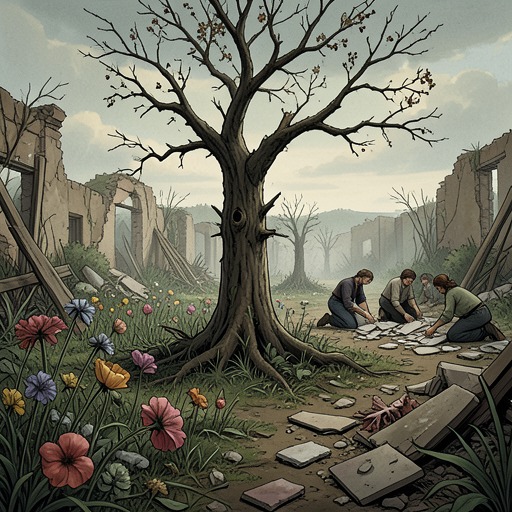
Yohan's garden in its destroyed and restored state
The Beki CEO Got Me PregnantYohan's garden in its destroyed and restored state is more than a piece of property: it is a recurring emotional and narrative space whose meaning changes after violence. First associated with Yohan's cultivated memories and flowers, the garden is suddenly bombed and reduced to wreckage. Because a planned date was supposed to take place there, the ruined site also becomes a near-fatal reminder of how narrowly Yohan and Kazumi escaped the attack. When the garden is rebuilt and redesigned, it does not simply return to normal. Its restoration preserves the memory of what was lost while allowing the place to host a later promise of love and family.
A Cherished Private Space
Yohan's garden stands near Yohan Xyle's Company and belongs to Yohan. Before the bombing, it was a place shaped by personal labor rather than merely displayed as an impressive possession: Yohan had planted and cared for many flowers there, and the garden held numerous memories for him. This history explains why the damage wounds him even though no person is injured. The garden's value is emotional and accumulated, built through repeated acts of planting, tending, and remembering.
The garden also carries the intimacy of a space chosen for a date. Its closeness to Yohan Xyle's Company links private affection with the public world surrounding Yohan, while its cultivated character offers a more personal setting than a workplace or mansion. The later discovery that the date might have occurred there makes the garden's earlier beauty inseparable from the danger concealed beneath it.
Bombing and Destruction
The garden's destruction is reported through an article that shocks Yohan: the garden near his well-known Company has allegedly been bombed, and the garden itself is said to have been completely destroyed. When Yohan leaves the mansion without telling Kazumi and rushes there by car, he finds that the report is true. The garden is in ruins, surrounded by caution tape to keep people out. No one has seen the perpetrator, and there is no CCTV in the area, making the search for the attacker especially difficult.
The attack produces public exposure as well as private loss. Yohan expects the bombing to become another major topic on Facebook, accompanied by questions from gossiping onlookers. Yet the social-media attention is secondary to the material fact of the ruined garden and to his grief over the flowers and memories destroyed with it. The absence of bodily casualties makes the bombing appear less serious in public terms, but the scene insists that damage without immediate death can still be intimate, frightening, and consequential.
The Garden as a Near-Fatal Turning Point
Standing before the wreckage, Yohan realizes how dangerous the original date plan would have been. The date was supposed to happen in the garden before he changed his mind and moved it elsewhere. His relief that he reconsidered is inseparable from the horrifying counterfactual: had he kept the original plan, he and Kazumi would have died, and the attack would have drawn even more intrusive attention. The garden therefore becomes a visible record of an avoided catastrophe. Its destroyed state transforms a romantic location into evidence of the fragility of both life and private intimacy.
The lack of CCTV leaves the attack unresolved at the scene, but Yohan forms a specific suspicion: Vixon. That suspicion places the garden within the broader conflict around Yohan and Kazumi and gives its destruction a human antagonist, even though the available account does not establish the culprit as fact. The garden's ruins consequently carry two kinds of uncertainty—uncertainty about who attacked it and the stark certainty that its former life has been violently interrupted.
Reconstruction and Return
The garden is eventually repaired before a later proposal. Yohan explains that the rebuilt garden is beautiful again, although he considers it less beautiful than the original, and even jokes anxiously about the possibility of another bomb. The comment preserves the attack inside the restored setting: reconstruction cannot erase the knowledge that the garden was once targeted. Beauty returns, but innocence does not return in exactly the same form.
Later, Yohan deliberately has the garden redesigned to resemble its pre-burning appearance. The result is described as beautiful, perhaps even more beautiful than before. When Yisha asks Kazumi to tie her hair because the wind is strong, the family gathers in this renewed space, and the garden is recognized as beautiful again. Its restoration thus moves beyond property repair. It becomes an act of recovering a shared visual and emotional world, with the old design functioning as a memory made tangible rather than a past perfectly restored.
Narrative and Thematic Significance
The garden's changing condition gives the story a compact image of vulnerability and repair. Its flowers represent care accumulated over time; the bombing represents sudden violence that destroys a protected private world; the rebuilt design represents an effort to preserve continuity while acknowledging irreversible damage. The contrast between the garden's apparent lack of importance to outsiders and its deep importance to Yohan makes the space a measure of whose losses receive attention. Public discussion focuses on the scandal and the unanswered questions, whereas Yohan experiences the garden as a repository of labor, memory, and threatened love.
Its recurrence also binds danger to domestic and romantic hope. The same location that could have become the scene of Yohan and Kazumi's deaths later becomes the setting for a proposal and a family gathering. That reversal does not cancel the bombing; it gives the restored garden a layered meaning. The place stands for survival precisely because its beauty is remembered as damaged, rebuilt, and consciously tended again.